

Organizations looking for a quick and comprehensive list of potential funding sources might have luck identifying opportunities with new AI technologies. AI – or artificial intelligence – has become more accessible through free programs that enable users to harness the power of AI using simple commands and prompts. When used correctly, these programs can help organizations quickly find information and summarize important details so you can spend less time on dead-end searches and more time focused on developing strong grant proposals.
At the Heartland Environmental Justice Center, we’re testing these technologies to understand how they can benefit communities, streamline the grant development process, and make finding information about funding opportunities more transparent. We’ve gathered a few tips and tricks, including an example of how the Environmental Director at the Kickapoo Tribe in Kansas uses AI to streamline operations and reporting. Continue reading to learn about the benefits, uses, and limitations of AI chat software, and why you might consider using these tools on your next project.
If you have used AI tools before and just want to know how to use them for identifying grants, an example of how to write prompts to search for funding is included in the “How to Use AI Search to Find Funding Opportunities” section below.
Getting Started with Artificial Intelligence Tools
There are a variety of AI programs available to help you optimize your workflow. One of the most popular options, ChatGPT, allows anyone with an email address to create a free account. Consider spending some time searching “free AI search engines” to find a program that you feel most comfortable signing up for to test. Not all programs require a sign in and many have additional paid features. The remainder of this article will reference ChatGPT, but the tips should readily apply to whatever software you choose.
It’s best to think of AI programs like a virtual assistant – good at helping you get started and increase productivity, but limited in its ability to generate unique content and ideas. We’ll dig deeper into the limitations of AI in the grant proposal process later on in this article. But please keep in mind that all information should be cross-checked and that these tools should never be exclusively relied on to draft new grant proposals because of serious concerns with plagiarism and accuracy.
After you’ve created an AI account, you’re ready to start testing your new virtual assistant! You can test the search capabilities by entering prompts like “What are the funding priorities in the Inflation Reduction Act?” Maybe you’re not super impressed yet because these are all things you could simply enter into any search engine. But hopefully, the information feels a bit more digestible and direct.
The Benefits of Using Artificial Intelligence for Grant Research
The main benefit of using AI software to search for funding opportunities is its ability to generate results across multiple sources. If you’re interested in knowing the full scope of opportunities, a quick AI search can provide a comprehensive list of what your project might be eligible for at the federal, state, local, and private foundation levels. Instead of having to visit multiple databases for grants tied to a particular agency or funder, you can enter your project details and get potential funding opportunities all in one place. The ability of AI to search across multiple sources, catalog the results, and summarize important details, all in just a few seconds, makes it a helpful first pass and an easy starting point to generate ideas.
Another reason you might use AI to explore funding opportunities is that it can potentially help you find new sources of funding. Because of its ability to quickly identify results across multiple sources, you might be surprised to find some new and exciting opportunities worth exploring.
Finally, because of the conversational nature of AI, the descriptions of the funding priorities tend to be more digestible. These tools do a good job of avoiding jargon and providing concise summaries that make it easy to tell if it’s worth finding out more.
The Limitations of Using Artificial Intelligence for Grant Research
AI search features pool information across a lot of sources, and sometimes that information can be outdated or inaccurate. That’s why it’s important to use this information only as a starting place and visit each funder’s website for the specifics of the grant requirements and timeline. Always follow the directions and deadlines found on the official funding agency’s website.
While we’re excited about the possibility of AI to streamline the grant search, a lot of caution should be exercised around using it for the development of grant narratives. Because the tool learns and processes information through other sources, any narrative could be subject to plagiarism, and the underlying data risks being unreliable. Until we have a better grasp of these tools, it’s best to use AI tools to search and summarize large sources of information rather than develop original descriptions. Instead, if you want help with grant development after you have identified a few funding options, we suggest reaching out to us and we can help you take the next step!
Case Study: Leveraging AI for Environmental Management at the Kickapoo Tribe

Eric Sheets, J.D., is the Environmental Director at the Kickapoo Tribe in Kansas. Since early 2022, he has been using AI technology, particularly ChatGPT, to enhance his workflow and productivity. Eric’s interest in technology and AI’s potential to boost organizational capacity motivated him to explore this tool. Through trial and error, he has developed methods to manage data-intensive tasks, streamline operations and reporting, and provide accurate, timely information to tribal leadership. Eric is optimistic about AI’s ability to reduce the administrative burden of federal grants.
When Eric started with the Kickapoo Tribe in early 2023, it was undergoing a significant leadership transition. His first task was to retroactively catch up on quarterly reports. Without any institutional knowledge to rely on, Eric devised a way to organize and analyze vast amounts of information, including emails, calendar entries, and other documents. He began experimenting with ChatGPT to summarize these entries and match them to outcomes he was required to report against. Eric’s use of AI quickly expanded as he discovered more sophisticated ways to leverage the technology. By uploading large documents and creating a library of relevant sources, Eric trained ChatGPT to provide specific analyses and generate comprehensive reports. This capability proved invaluable when he needed to sift through hundreds of emails to extract pertinent details for impending deadlines. AI’s ability to synthesize data from multiple sources into coherent narratives allowed Eric to catch up on reporting requirements while streamlining the process moving forward.
Eric has also utilized AI to automate the creation of various documents, such as tribal ordinances, templates, and standard operating procedures. By combining information from multiple documents and his own notes, he has produced high-quality outputs that saved significant time and effort. One notable success was the development of a standardized template for tribal council briefings, which improved communication and decision-making processes across different departments.
Despite these successes, Eric notes the challenges of using AI, particularly the need for careful analysis to avoid errors. Ensuring AI accuracy requires strong skills in writing, reading, and data analysis. Eric stresses the importance of inputting clean, relevant data to prevent inaccuracies and avoid AI instances of “fill-in-the-blank.” He recommends meticulous scrutiny and advises against using AI as a shortcut but rather as a tool for efficiency. Eric suggests that organizations should establish clear boundaries and strict parameters for AI use when getting started.
How to Use AI Search to Find Funding Opportunities
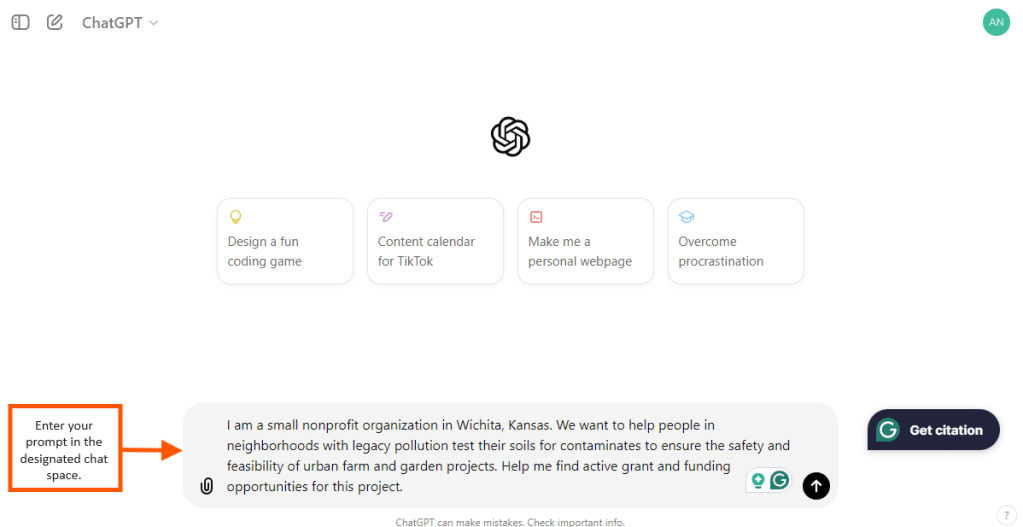
- Enter the type of organization, an overview of the project or idea, and who and where you serve. For example: “I am a small nonprofit organization in Wichita, Kansas. We want to help people in neighborhoods with legacy pollution test their soils for contaminants to ensure the safety and feasibility of urban farm and garden projects.”
- A general rule of thumb is that the more information you can enter, the better and more accurate your results should be.
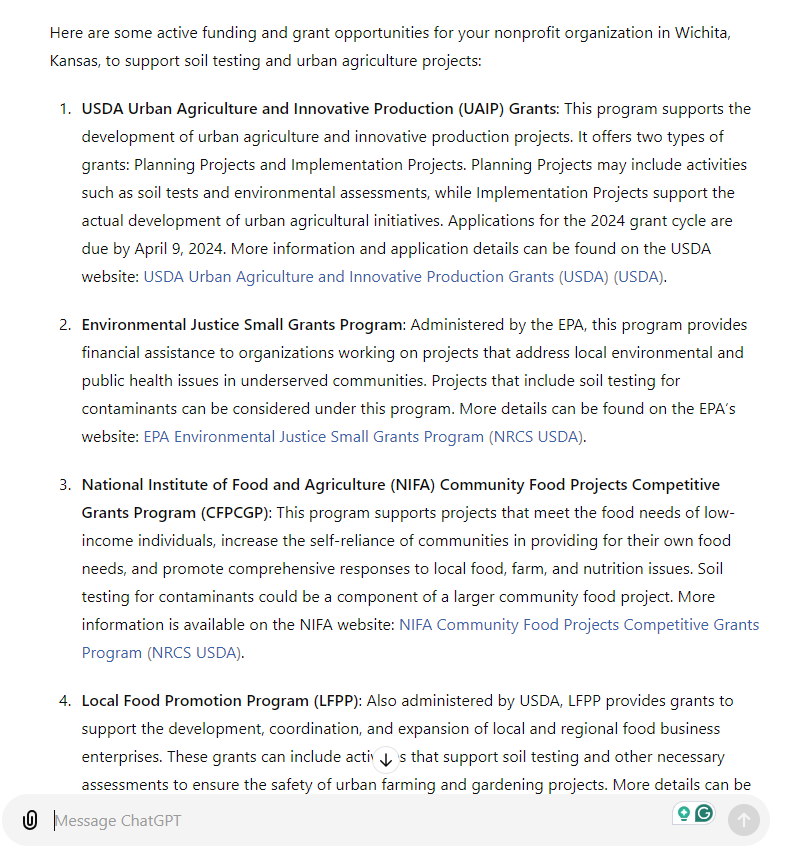
- Next, enter a prompt like, “Help me find active funding opportunities for this project.” It is important to include the word “active” otherwise you might end up with a long list of closed grants. You can also play with adding prompts for specific sources such as “Help me find active federal and state funding opportunities.” This can take some trial and error but the good news is that the results generate quickly so you’ll know within seconds how to refine your prompt.
- Use the results as a springboard. Follow the links to the funding source’s website to cross-check details and learn more.
- Continue to refine your prompt until you get better results. You can do this by treating your entries into the AI tool as a conversation. For example: “That funding opportunity was for rural communities. I would rather see funding opportunities that focus on urban communities.”
If you’ve already been thinking about using AI as a tool to find grant resources, now you’re ready to go! As mentioned, this is a complementary way to search and you should continue to reference your other favorite sources as usual. And if you feel stuck, we’re here to support you in your search for grant opportunities for your environmental justice project or idea. Reach out today to get started.
Keeping Things in Perspective: The Current Environmental Injustices of Artificial Intelligence
Note that AI tools require a concerning amount of energy to power them (scientists estimate that by 2027 global A.I. data centers will require 85.4 terawatts of electricity annually, which is equal to the annual electricity usage of many small countries), water to cool them (while 1.1 billion people lack access to clean and safe water, AI data centers are expected to consume 6.6 billion m³ by 2027), cheapened and exploited labor working in data sweatshops to train the AI models (most AI users outsource this labor to underdeveloped countries with racialized workforces and limited labor protection laws), the underregulated mining of minerals needed to build the technologies used in AI (an industry that often sees illegal land grabs from Indigenous communities opposed to mining and the production of labor conditions that are themselves environmental injustices with constant exposure to polluted air, water, and environments), and a digital technology supply chain that has no ability to manage e-waste (most often seeing overdeveloped countries in the West shipping their e-waste and the environmental harms of that waste to underdeveloped countries in the South and East).
So, while AI tools may be able to help grassroots organizations speed up the process of identifying funding sources, we must recognize the environmental injustices that are perpetuated by this technology in communities around the world. From the sourcing of the materials needed to build AI tools, to the powering of the AI data centers, to the training of the AI models, to the e-waste produced when AI tools become obsolete or broken, environmental injustice occurs at every stage of AI’s lifecycle. Although these impacts are geographically dispersed and sometimes hard to see, many communities are increasingly experiencing and resisting the consequences of an underregulated global economy reliant on unethical extraction and exploitation to power digital technologies.
 Heartland Environmental Justice Center
Leave a comment